Klang 9 is a freight forwarding and customs brokerage business working the Laem Chabang port corridor. Their operations used to live in spreadsheets: bills of lading, vessel manifests, container returns, customs stages, and the free-time clocks that decide whether a container earns money or burns it.
What we built
One backend, five applications — each shaped for the people who use it:
- ERP back office — the full shipment lifecycle keyed on the bill of lading: shippers, agents, vessels, containers, delivery orders, releases, and returns, with a live operational dashboard.
- Free zone suite — the customs pipeline modeled as explicit, timestamped stages (issue, submit, approve, shipped), linked to chassis, export gates, and invoices.
- Transport dispatch — truck and driver assignment with boards for “awaiting assignment” and “awaiting return.”
- Customer service portal — attaching customers to shipments and managing the directory.
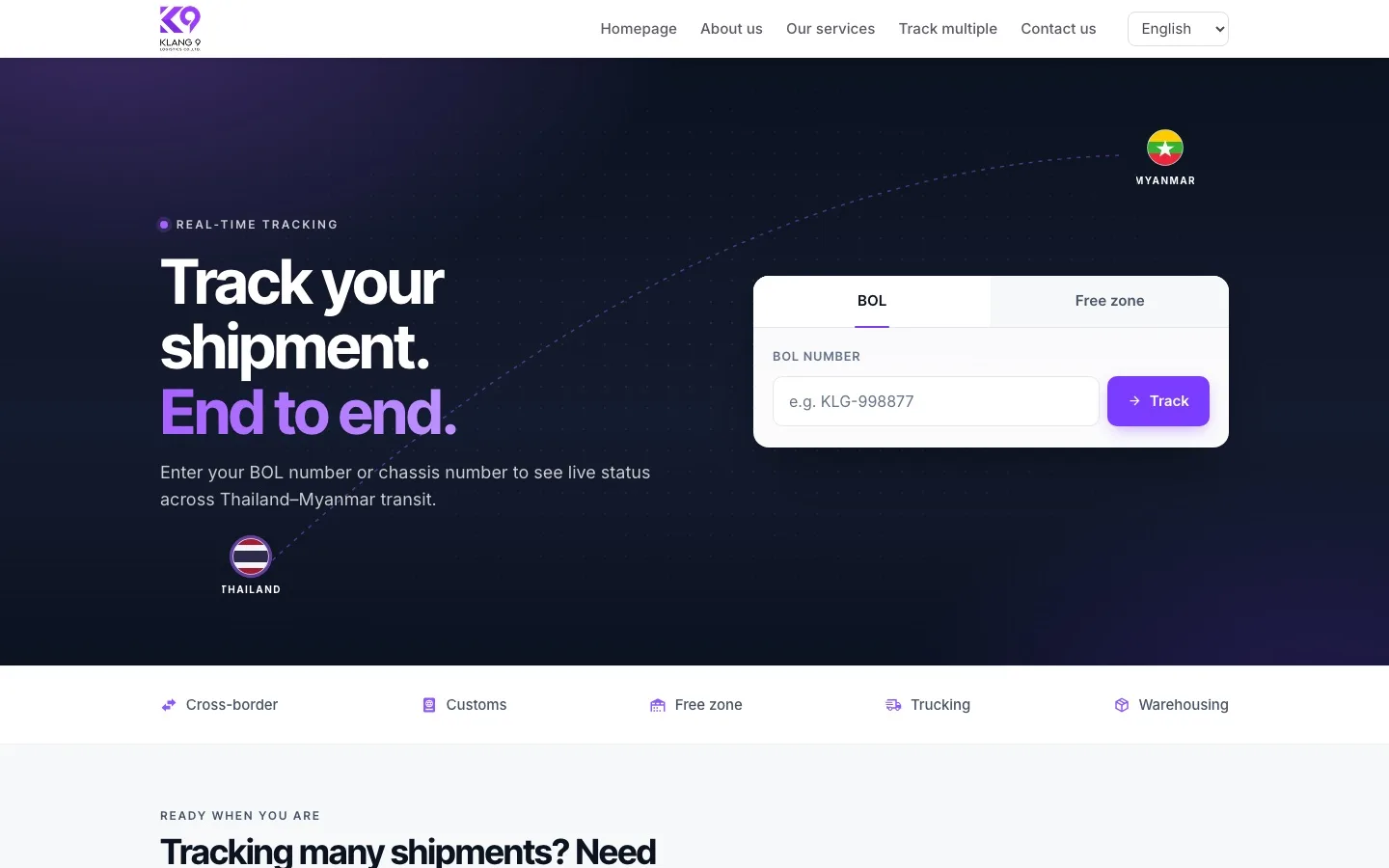
- Public tracking site — anyone can track a shipment by bill of lading or chassis number, backed by the same live data the team works from. Ships in English, Thai, Chinese, and Burmese — the languages of the trade lane it serves.
The part we are proud of
Demurrage and detention deadlines — the fees that stack up when containers sit too long — are computed automatically from ETA and release dates, in both separate and combined free-time modes. That is the spreadsheet nobody at a freight forwarder wants to maintain by hand, and it now maintains itself.
In production
Live daily operations across sixteen domain models and three role-scoped internal apps. We still ship operational fixes as the business evolves — that is the relationship, not an afterthought.